Emergency Bail Release From Guilford County Detention Center
When someone is booked into the Guilford County Detention Center, time slows down for families. Phones ring without answers. Worry sets in. The next call needs to be to a local bondsman who knows the Greensboro jail, the Guilford County Magistrate’s Office, and exactly how to move a bond from talk to posted paperwork fast. This page explains, in clear terms, how emergency bail release works at 201 S Edgeworth St in Greensboro, why proximity and process knowledge compress the timeline, and how families can use interest-free financing to cover the state-regulated premium without turning to high-cost lenders. The tone stays calm because that helps people make good decisions in a hard hour.
Why Greensboro Families Need Emergency Bail Release That Works Without Delay
Greensboro is the seat of Guilford County and a busy arrest district. The Guilford County Detention Center at 201 S Edgeworth St, Greensboro, NC 27401, phone (336) 641-2700, runs around the clock. The Magistrate’s Office inside the same complex sets bond conditions 24 hours a day. That means an emergency call at 1:15 a.m. Can still turn into a posted bond by 2:30 a.m. If the bondsman is close and the co-signer is qualified. Typical release time after the bond is posted runs 2 to 4 hours depending on booking volume and shift change. Families in Downtown Greensboro, College Hill, Fisher Park, and Lindley Park see the difference when their bondsman is one block away instead of across the county.
Emergency release is not only about speed. It is also about accuracy. If the bond is written with a typo in the case number, if a name does not match the booking record, or if the wrong facility gets called, the clock keeps running. Local bondsmen who work Greensboro daily avoid those errors because they already speak the detention center’s language and know the magistrate clerks by role. They know the jail’s busiest windows, how the shift overlaps affect release runs, and how to confirm a bond number and charge code before driving over. That saves families hours they do not have.
How Emergency Bail Release Actually Works From Arrest Through Release
The emergency release sequence in Greensboro follows a predictable arc. After arrest, the defendant goes to the Guilford County Detention Center for booking. Booking includes fingerprints, photographs, a check for warrants, and entry into the jail system. The magistrate then sets pretrial release conditions. In plain English, these are the rules and costs that must be met before the person can leave the jail. Release conditions can be a written promise to appear, an unsecured bond, a secured appearance bond, or non-financial terms like electronic monitoring. Under current practice, most cases that reach a bondsman involve a secured appearance bond, which is a bond that requires cash or a surety bond through a licensed agency.
Once bond is set, the operational flow that shortens release time looks like this. First, the bondsman confirms the exact bond amount, the booking number, and the charge level in the jail system. Second, the co-signer and bondsman formalize the surety agreement, which is the contract that says the bondsman will guarantee the defendant’s court appearance. Third, the bondsman posts the bond at the magistrate’s office inside 201 S Edgeworth St. Fourth, the jail processes the release. In most Greensboro cases that process takes 2 to 4 hours after posting, with faster runs in low-volume windows and longer runs during shift changes, which often happen around early morning and late evening.
There is an advantage that matters in real minutes. A bondsman based one block from 201 S Edgeworth St can walk the paperwork to the magistrate in minutes. That trims 30 to 60 minutes that out-of-town bondsmen lose to travel and parking. It also avoids courier handoffs and keeps communication tight if a clerk needs a quick correction. The savings stack up when large bonds are involved because the magistrate’s office must check more pages and may ask for a second signature from an accommodation bondsman on very high amounts. A local agency used to six-figure bonds clears these checks faster because the forms, collateral statements, and indemnity schedules arrive complete the first time. That is how a $250,000 secured bond posted in under 2 hours in Greensboro is not a story, but a documented track record.
What Families Should Have Ready When Calling For Emergency Help
Every minute counts when someone is sitting at 201 S Edgeworth St. Having a few items ready will help a bondsman verify and post faster. This is not a how-to list. It is a short set of details that make the call go smoothly and cut down on back-and-forth while the magistrate window is open.
- Defendant’s full legal name, date of birth, and if possible the booking number or case number Exact bond amount and charge, if known, or when and where the arrest happened Co-signer name, age 25 or older, with employment information and a working phone number Address within 45 miles of the Guilford County Courthouse at 201 S Eugene St, Greensboro, NC 27401 Two recent pay stubs or income proof and a utility bill that matches the co-signer’s address
If any of these items are missing, a local agency can still start the process. The jail’s own systems can provide basic confirmation. The Guilford County inmate search at https://inmatesearch.guilfordcountync.gov/ often shows bond amounts and charge codes. A quick look-up gets the bondsman and co-signer on the same page without delay.
Greensboro Neighborhood Coverage And County Context
Families call from across Greensboro and the Triad at all hours. Emergency release requests come from Downtown Greensboro, Glenwood, Adams Farm, Friendly Center, Hamilton Lakes, Irving Park, Sunset Hills, Westerwood, Aycock, Ole Asheboro, South Elm, Green Valley, Starmount, Sedgefield, New Garden, the Guilford College area, and along the Battleground Avenue and Wendover Avenue corridors. Calls also come from Jamestown, Summerfield, Oak Ridge, Pleasant Garden, Stokesdale, Colfax, McLeansville, and Gibsonville. High Point cases route to the Guilford County High Point Detention Center at 507 East Green Drive, High Point, NC 27260, phone (336) 641-7900, where the magistrate office also processes bonds 24 hours a day.
Zip codes matter for underwriting and court scheduling. Greensboro zip codes include 27401, 27403, 27405, 27406, 27407, 27408, 27409, 27410, 27411, 27412, 27413, 27415, 27416, 27417, 27419, 27420, 27427, 27429, 27435, 27438, 27455, 27495, 27497, 27498, and 27499. Guilford County extended coverage includes 27282 for High Point, 27310 for Jamestown, 27249 for Gibsonville, 27358 for Summerfield, 27214 for Oak Ridge, 27377 for Pleasant Garden, 27410 for Stokesdale, 27235 for Colfax, and 27301 for McLeansville. Triad families with ties in Rockingham County often call from Reidsville, Eden, Madison, Mayodan, and Stoneville, which route through the Rockingham County Detention Center at 170 NC-65, Reidsville, NC 27320, phone (336) 634-3232. Cross-county familiarity helps when a defendant is picked up on a Guilford warrant in a neighboring county.
The North Carolina Legal Framework That Shapes Emergency Release
North Carolina law sets the structure for pretrial release. N.C. Gen. Stat. §15A-531 defines a bail bond and related terms in plain English as the promise, backed by money or a surety, that a defendant will come to court. N.C. Gen. Stat. §15A-533 and §15A-534 describe who gets presumed conditions for release and what those conditions may be. In simple terms, the magistrate or judge must choose the least restrictive condition that will reasonably assure appearance and public safety. For many charges that means a secured appearance bond, which requires either a cash deposit or a surety bond through a licensed agency. N.C. Gen. Stat. §15A-535 guides county pretrial policies, which Guilford County follows through the magistrate’s 24-hour office inside the detention complex.
On cost, the premium a bondsman may charge is capped by N.C. Gen. Stat. §58-71-95. In plain language, the law sets a maximum fee at 15 percent of the total bond amount or $150, whichever is greater, for a state court bond. That fee is the nonrefundable premium paid to the bondsman for taking on the risk. Emergency release does not change the premium cap. What can change is how that premium is paid. Interest-free financing and low down options can spread that regulated fee across weeks or months without adding finance charges, which keeps families out of payday loan cycles.
There are also new constraints for violent offenses under Iryna’s Law, Session Law 2025-93, effective December 1, 2025. For violent charges, which the law defines to include Class A through G felonies involving assault, force, or threats of force, there is a rebuttable presumption against release. That phrase means the default assumption is no release condition will work unless the defense provides evidence to overcome it. For a first violent offense, the judicial official must impose either a secured bond or house arrest with electronic monitoring. For a second violent offense, house arrest with electronic monitoring becomes the baseline. The law also removed the option of a written promise to appear as a stand-alone release condition across charge categories. In emergency calls, this means families should expect secured bonds more often in serious cases and should be prepared for higher amounts or additional conditions.
Judges also must make written findings of fact when they deviate from standard release factors in certain cases. The clerk’s use of the AOC-CR-200 form and the requirement to check criminal history, often within a 10-year lookback under G.S. 15A-523, add a few minutes to paperwork at the window, but they guide consistent decisions. If the bond later becomes an issue, such as after a missed court date, the 90-day bond forfeiture timeline controls how the court notifies the surety and when a forfeiture becomes final. A knowledgeable bondsman tracks those deadlines and works with counsel on set-aside motions when appropriate. All of this legal framework is meant to be invisible to the family at 2 a.m., but it matters to the speed and safety of an emergency release.
What Emergency Release Looks Like Inside The Guilford County Detention Center
The Guilford County Detention Center houses both pretrial detainees and inmates serving short sentences. The magistrate’s bond window sits inside the complex at 201 S Edgeworth St. When a surety bond is posted, the clerk stamps the face sheet, enters the bond into the jail’s system, and notifies the housing unit. Release then runs through property return, fingerprint confirmation, and slotting the person into the next scheduled release run. Most families in Greensboro see a 2 to 4 hour release window after posting. That is an honest range that depends on staff levels, the number of transports coming in from High Point or state agencies, and whether classification needs to re-verify identifiers before release.
There are differences between day, evening, and overnight releases. Daytime sees the heaviest volume and the most court https://s3.us-east-005.backblazeb2.com/apex-bail-bonds-nc/greensboro/bail-bond-payment-plans-in-greensboro-nc.html transports. Evening can be steady with DUI and domestic bookings. Between 1 a.m. And 5 a.m. The pace is mixed. The short overnight window can be very fast when volume is light, or slower if classification runs with minimal staff. A bondsman who can put the bond on the window minutes after approval wins either way. Families often ask about weekend or holiday releases. The answer is yes. The magistrate’s office does not close. Weekend releases follow the same 2 to 4 hour pattern after posting, with occasional delays if a holiday weekend stacks transports or if snow or ice affects staff travel in the Triad.
How Interest-Free Financing Fits An Emergency Release In Greensboro
Many families cannot pay the full premium at 2 a.m. That is normal. North Carolina allows bondsmen to finance the premium as long as the agency follows the fee cap in N.C. Gen. Stat. §58-71-95. In plain English, the premium is still capped. The financing does not add interest or hidden charges when structured as interest-free installments. This is where the phrase bail bond payment plans Greensboro shows up in late-night searches. The concept is simple. A qualifying co-signer pays a small portion of the premium up front. The rest is paid over time without interest. The bond posts right away because the premium is secured by the co-signer’s promise and, when needed, collateral.
Two common emergency structures are half-down-half-later and five percent down for bonds $5,000 and up. For example, on a $7,500 bond, the premium at the 15 percent cap is $1,125. A five percent down structure would collect $375 up front and finance the remaining $750 across scheduled payments without interest. On a $10,000 bond, the premium at the cap is $1,500. A five percent down structure collects $500 up front with $1,000 financed across installments the family can manage. On larger bonds, case-by-case structures apply, but the core approach is the same. There are no financing fees. There are no interest charges. There are no surprise add-ons buried in fine print.
Why does this matter in an emergency? Because the most dangerous minutes in an arrest are often the hours right after booking when the person is still in custody, when jobs and child care are disrupted, and when tempers run high. Financing lets a family choose a surety bond now, keep rent and utilities on track, and avoid short-term lenders that can charge triple-digit annual percentage rates. Emergency release and responsible financing go together. The law requires the premium cap. A serious Greensboro agency chooses to cap interest at zero.
Who Qualifies For Financing And What Collateral May Be Used
Emergency approval happens fast when the co-signer is ready and eligible. A strong co-signer is 25 years or older, has at least 12 months of continuous employment, can show a current utility bill that matches their address, and maintains an open checking account. A permanent residence within 45 miles of the courthouse that will hear the case shows ties to the area. A 24-month local residency is preferred but not mandatory in every case. When a co-signer does not hit every marker, exceptions may be granted case-by-case based on work history, homeowner status, or veteran status.
Collateral is not always required. When it is, Greensboro agencies accept common forms that match the bond risk. A car title with a temporary lien is straightforward when the vehicle is paid off or has equity. A real estate deed of trust can be used on homes with 100 percent equity, which means the mortgage is paid off and there is no other lien. Stocks and securities can sometimes back a bond when they are held in a verifiable account. Jewelry and electronics typically support smaller balances because resale value swings. Non-titled personal property is considered case-by-case and may involve a bill of sale. Larger commercial items can call for UCC financing and termination statements to record and later clear a lien. The goal is always to use the least intrusive collateral that still secures the bond.
Co-signers should understand liability in plain English. If the defendant misses court, the court issues an order called a forfeiture. The surety then has a legal duty to either return the defendant to custody or pay the bond. The co-signer’s agreement makes them responsible for the premium balance and any losses caused by a failure to appear. That is why agencies emphasize steady employment and local ties. Those reduce failure to appear risk and protect the co-signer from collateral loss. A local Greensboro agency will also help with court date reminders, address updates, and quick response if a missed date can be cured the same day by getting to the clerk’s office before a forfeiture hits the calendar.
Charge Types That Shape Emergency Decisions
Not every charge affects emergency release in the same way. Misdemeanor bonds often post with minimal collateral and a simple co-signer, especially for first-time charges. DWI bonds in Guilford County can vary depending on aggravating factors under N.C. Gen. Stat. §20-138.1, but they often post overnight with standard premium and scheduling terms. Domestic violence arrests can trigger a cooling-off hold before a judge sets bond, which means the first bond decision may not happen until the next session. Assault charges split between simple assault and more serious forms like assault with a deadly weapon, which can drive higher secured bonds. Drug trafficking charges, particularly those tied to mandatory minimums under N.C. Gen. Stat. §90-95(h), tend to carry higher bonds and require stronger collateral and multiple co-signers.
For violent felony cases that fall under Iryna’s Law, emergency release still exists, but the path changes. A rebuttable presumption against release exists for the listed violent offenses, which means the default is no release unless the defense shows evidence that release can be safe and reliable. First violent offenses require either a secured bond or house arrest with electronic monitoring. Second violent offenses raise the bar to house arrest with electronic monitoring as the baseline. Families should expect a secured bond rather than an unsecured one in those cases, and they should prepare for a higher premium and stricter underwriting. A local agency that understands the magistrate’s current reading of Iryna’s Law can give a realistic timeline and financing path so the family is not caught by surprise.
Guilford County Detention Center Release Workflow And Timelines
After a bond is posted at the magistrate’s counter inside 201 S Edgeworth St, the jail activates its release workflow. The clerk confirms identity, validates the surety documents, and updates the jail system. Property and personal effects are matched to the outgoing inmate. Fingerprints and photos are checked one more time to avoid mistaken identity. The person is queued for the next release run. When volume is normal, that queue moves in 2 to 4 hours. When a bus from another facility arrives or a shift changes mid-process, the wait can push longer. Families in Greensboro should plan for this window and coordinate a pickup spot. The lot on South Edgeworth Street fills fast, and street parking on West Washington Street can be tight during weekday court hours.
For High Point cases at 507 East Green Drive, emergency release follows the same pattern. The magistrate’s office inside that detention center posts bonds 24 hours a day. Release runs can be quicker overnight because the volume is lower, but daytime can slow due to separate High Point court transports. A Greensboro bondsman who covers both facilities will confirm which jail has the defendant before driving to post. That one verification step avoids the most common emergency delay, which is a bond posted at the wrong building while the defendant sits across the county.
Cross-Border And Multi-County Considerations In Emergency Calls
Families with ties in Rockingham County, Alamance County, Forsyth County, or Southside Virginia often face a second layer of decisions. A defendant might be arrested in Greensboro on a warrant from Reidsville. Or a Guilford County resident might be booked in Danville, Virginia on a charge that requires transport back to North Carolina. A bondsman with licenses in both North Carolina and Virginia can coordinate those moves directly rather than sending the family to a second agency. That matters at midnight when the window to post in one county closes for the night and transport to another county looms at sunrise.
This regional coverage is common along the Piedmont Triad corridor. Greensboro cases sometimes thread through High Point, Jamestown, and Pleasant Garden addresses. Reidsville, Eden, and Madison cases can touch Guilford court calendars if charges stack. A bondsman who works both sides of the county lines keeps the paperwork consistent and eliminates errors that can happen when two separate agencies try to coordinate across state or county rules. Emergency release benefits from a single point of accountability.
A Shareable Local Fact About Greensboro Emergency Release
Greensboro families and defense attorneys often ask whether very large bonds slow the process. The answer is not if the agency is ready. At the Guilford County Detention Center, a $250,000 secured bond posted in under 2 hours is a documented outcome. That speed did not come from shortcuts. It came from proximity to 201 S Edgeworth St, one-block access to the magistrate’s office, and a large-bond workflow that the staff sees on a regular basis. In practice, a well-prepared six-figure bond can move faster than a poorly prepared $5,000 bond. Defense counsel and local legal reporters interested in pretrial operations can verify this pattern with magistrate clerks who see the difference that complete documents and immediate corrections make at the counter.
Why Emergency Financing Does Not Mean Predatory Terms
Families in a panic sometimes reach for cash from payday lenders or online quick-cash apps to cover a premium. Those loans can run annual rates well into triple digits, and hidden fees often stack with late penalties. Greensboro bondsmen who offer interest-free premium financing change that math. The premium remains the same state-capped amount under N.C. Gen. Stat. §58-71-95. The schedule spreads the cost without adding finance charges. A five percent down option on bonds $5,000 and up or a half-down-half-later structure on most bonds lets a co-signer protect rent, groceries, and utilities the same month the arrest happens. That is the core of bail bond payment plans Greensboro callers ask for late at night. The plan must be clear, charge no interest, and avoid hidden fees. Anything else is the wrong fit for emergency release.
What Happens If A Payment Is Missed After An Emergency Release
Life happens. A job changes. A paycheck hits late. The right move is to call the bondsman before a payment comes due and explain the issue. Most Greensboro agencies will adjust a date or split a payment once or twice if the co-signer stays in touch and the defendant is appearing in court. If contact breaks and payments stop, the agency has the right to request a bond surrender. In plain English, that means the bondsman can remove the surety and return the defendant to custody. That is a last resort. Agencies prefer to keep the bond in place if court dates are being met because surrenders cost everyone time and money. Good communication prevents most problems, and a local agency will outline the payment policy in writing so the co-signer knows exactly how to stay in good standing.
How Attorneys, Employers, And Family Coordinators Fit Into An Emergency Release
Defense attorneys often coordinate with the bondsman before a bond motion, especially under Iryna’s Law conditions. Clear evidence of residence, employment, and lack of violence risk can help a judge set a workable secured bond. Employers can help confirm job stability and shift coverage for the first week after release, which judges and magistrates like to see. A family coordinator, often a parent, spouse, or adult child, helps keep documents, track payments, and handle court reminders. Emergency release works best when one responsible person serves as the point of contact. A Greensboro agency used to late-night calls will ask early who that person is so that information, reminders, and updates do not get lost in group texts.
What To Expect On The First Court Date After An Overnight Release
The first appearance is where a judge reviews bond conditions and sets the next court date. In Guilford County, first appearances are usually held at the Guilford County Courthouse at 201 S Eugene St, Greensboro, NC 27401, phone (336) 412-7300. If Iryna’s Law applies, the judge may require written findings to keep or change the bond. The defense can ask for a bond reduction if circumstances support it. A bondsman with case knowledge can give a simple letter confirming timely payments, current contact info, and successful compliance with release terms. That does not decide the motion, but it helps tell a steady story. If the court keeps the bond in place, the surety continues under the same premium agreement and payment plan that was built the night of the arrest.
Emergency Release In High Point And Countywide Coordination
High Point arrests go to the Guilford County High Point Detention Center at 507 East Green Drive, phone (336) 641-7900. The same emergency principles apply. The magistrate office processes bonds 24 hours a day. Release time runs a similar 2 to 4 hours after posting. A Greensboro-based bondsman who covers High Point can confirm location within minutes and post at the right window. Families in Downtown High Point, Oakview, Deep River, and Emerywood should expect the bondsman to ask the same intake questions as Greensboro calls. The financing structures also match, with interest-free options and five percent down for bonds $5,000 and up when the co-signer qualifies.
Why Proximity To 201 S Edgeworth St Changes Outcomes
There is a reason experienced attorneys tell families to choose a bondsman who can walk to the magistrate’s office. One block from the Guilford County Detention Center means less time driving, parking, and shuttling documents. It also means the bondsman can fix a typo, add a missing initial, or respond to a clerk’s question in minutes without rescheduling. Paperwork tends to be cleaner when the agency and the magistrate staff see each other daily. That trust, built over time, leads to faster posting and fewer rejects. Emergency release benefits most from this daily familiarity. In plain English, a one-block walk beats a 45-minute drive when someone is waiting behind the glass.
Clear Answers To Common Emergency Questions
How long does release take after posting in Greensboro? In most cases, plan for 2 to 4 hours. Can a bond post overnight or on weekends? Yes. The magistrate’s office is 24/7. Can a family pay the premium over time? Yes, as long as the total premium stays within the 15 percent cap under N.C. Gen. Stat. §58-71-95, and the financing carries zero interest and no hidden fees. What if the defendant lives in Summerfield or Oak Ridge? That is within the Guilford County radius and fine for underwriting. What if there was a missed court date before? bail bond payment plans Greensboro The bond may still be possible, but underwriting will ask for a stronger co-signer or collateral. Can a homeowner get a better rate? Many Greensboro agencies offer special rates for homeowners, veterans, attorney referrals, and returning clients. Large bonds may qualify for special low rates as well.
Why Greensboro Families Call Apex Bail Bonds For Emergency Bail Release
Apex Bail Bonds operates one block from the Guilford County Detention Center at 201 S Edgeworth St. The Greensboro office is at 101 S Elm St, Suite 80, Greensboro, NC 27401. Proximity matters in emergency calls because it turns approval into posting within minutes. Apex is a North Carolina Department of Insurance licensed surety bail bonds agency, NCDOI License #18812863. Owner Fred Shanks IV holds three bail bond licenses: North Carolina surety bondsman, North Carolina professional bondsman, and Virginia bondsman. That tri-licensed authority supports cross-state coordination when a Greensboro arrest intersects with Rockingham County or Southside Virginia ties.
Families who need fast jail release at night also need financing that will not punish them later. Apex structures interest-free bail bond payment plans in Greensboro with zero financing fees and no hidden costs. On bonds $5,000 and up, five percent down options are available for qualified co-signers. Half-down-half-later plans are standard on many bonds. Same-day approval is common when the co-signer is age 25 or older, shows at least 12 months of continuous employment, provides two pay stubs and a matching utility bill, and lives within 45 miles of the courthouse. Special rates are available for homeowners, veterans, attorney referrals, and returning clients. Case-by-case exceptions are made when strong employment history or local ties offset other factors.
Large bonds do not slow Apex. The agency has a documented track record of posting a $250,000 bond in under 2 hours at the Guilford County Detention Center. The team writes six-figure and million-dollar bonds and coordinates additional signatures when an accommodation bondsman is needed. Apex handles misdemeanor, felony, DWI, domestic violence, assault, drug trafficking, probation violation, and failure to appear bonds, and provides 24/7 emergency service including weekends and holidays. Payment can be made by cash, credit card, debit card, online payments, Zelle, and check.
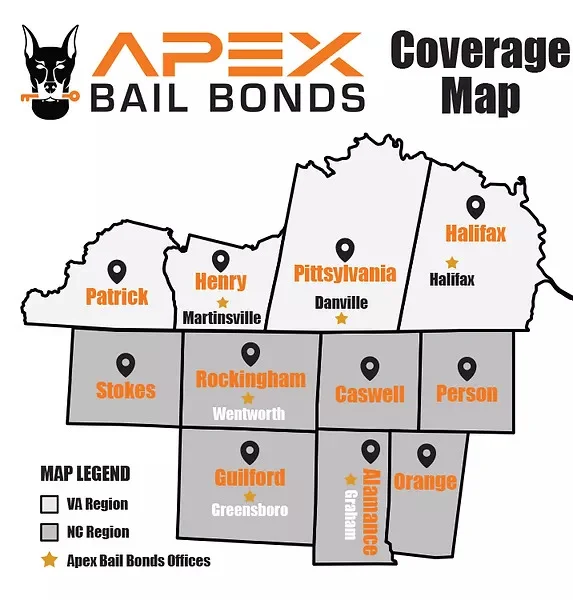
If someone is at 201 S Edgeworth St right now, the call needs to be quick and clear. Apex Bail Bonds answers the phone 24 hours a day, 7 days a week, 365 days a year. For Greensboro emergency bail release and interest-free financing, call +1-336-609-1190. For Reidsville, Graham, and the broader NC and VA service area, call +1-336-394-8890. More information is available at https://www.apexbailbond.com/ and the Greensboro service page at https://www.apexbailbond.com/greensboro-nc. Apex covers Guilford County, Rockingham County, Alamance County, and the broader Piedmont Triad corridor. Licensed and bonded under NCDOI #18812863. Bail bond payment plans Greensboro inquiries are always welcome, day or night.
Service Area Snapshot
- Primary coverage: Greensboro 27401, 27403, 27405, 27406, 27407, 27408, 27409, 27410, and surrounding zip codes across Guilford County Neighborhoods: Downtown, College Hill, Fisher Park, Lindley Park, Adams Farm, Friendly Center, Glenwood, Irving Park, Hamilton Lakes, Sunset Hills, Westerwood, Aycock, Ole Asheboro, South Elm, Green Valley, Starmount, Sedgefield, New Garden Adjacent cities: High Point, Jamestown, Gibsonville, Summerfield, Oak Ridge, Pleasant Garden, Stokesdale, Colfax, McLeansville Nearby facilities: High Point Detention Center, 507 East Green Drive, High Point, NC 27260, phone (336) 641-7900 Inmate search: https://inmatesearch.guilfordcountync.gov/ and courthouse info at 201 S Eugene St, Greensboro, NC 27401, phone (336) 412-7300